
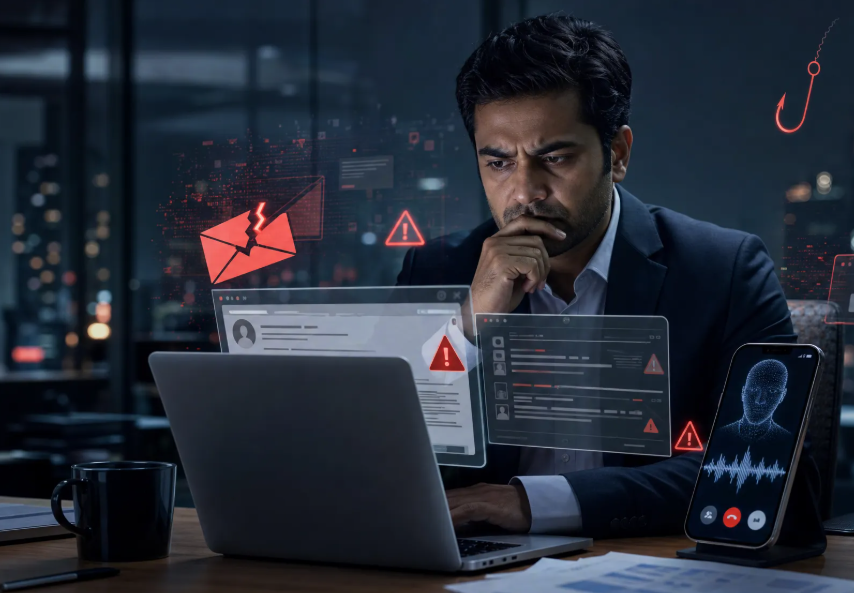
AI-Powered Phishing Has Changed the Game: Why Traditional Email Security Is No Longer Enough
April 2026
For years, the advice was simple: look for spelling mistakes, be suspicious of urgent requests, hover over links. That advice no longer works. AI-generated phishing and business email compromise now account for 22% of all cyber incidents in India, and the attacks produced by these tools are sophisticated, personalised, and indistinguishable from legitimate communication — even to trained eyes.
The change is structural, not incremental. Generative AI gives attackers the ability to craft highly contextualised messages using publicly available information about targets — their role, their colleagues, their recent activity, their company’s vendors. Deepfake voice cloning means a CFO can receive a phone call that sounds exactly like the CEO, instructing them to approve a wire transfer. Automated variant testing allows attackers to run campaigns at scale, optimising messaging the way marketers optimise conversion rates. The quality of social engineering has improved by an order of magnitude, and it is available to any threat actor with a modest budget.
The Attack Patterns That Are Causing Real Losses
Business Email Compromise (BEC) remains the highest-value fraud vector. An attacker compromises or spoofs a vendor’s or executive’s email account and introduces fraudulent payment instructions into an existing, legitimate business conversation. The target sees a familiar thread, a familiar name, and a plausible request. The financial loss from a single successful BEC attack can range from lakhs to crores — and recovery is typically impossible once funds are transferred.
Vishing and deepfake voice fraud are accelerating. In documented incidents from 2025 and early 2026, attackers used cloned voice audio to impersonate senior executives over phone calls, directing finance or HR staff to take high-value actions. The calls sound authentic because they are built from publicly available audio — interviews, conference talks, social media videos. Detection relies entirely on out-of-band verification processes that most organisations have never implemented.
AI-optimised spear phishing targets specific individuals with emails that reference real projects, real colleagues, and real business context scraped from LinkedIn, company websites, and breach databases. The traditional advice of “don’t click unknown links” breaks down when the link appears to come from a known contact referencing a real conversation.
Why Perimeter Defences Are Insufficient
Phishing is responsible for roughly 30% of all ransomware incidents. Remote access compromise accounts for another 40%. Together, these two social engineering vectors account for the majority of initial access in successful attacks. Firewalls, antivirus, and endpoint detection tools are not designed to catch these — they occur at the human layer, above the network perimeter.
The implication is important: an organisation can have strong technical controls and still be compromised because a finance manager approved a payment based on a convincing fake email or phone call. Security infrastructure that monitors only the network layer has a blind spot at the most common entry point.
Defending Against AI-Enhanced Social Engineering
The response to AI-enhanced phishing is not simply “better spam filters.” It requires a layered approach that combines technical controls, process controls, and human training.
- Out-of-band verification for high-value actions. Any bank detail change, payroll modification, or large transfer request should require a separate, pre-established verification step — not a reply to the same email thread, and not via a phone number provided in the request itself.
- Dual-approval for financial transactions. A single point of human authorisation is a single point of failure. Any transaction above a defined threshold should require two independent approvers using different channels.
- Phishing-resistant MFA. Standard SMS-based two-factor authentication can be bypassed through real-time phishing kits. Hardware keys or authenticator-based MFA for finance and admin accounts significantly raises the bar.
- Anomaly detection in email and authentication logs. Login from an unfamiliar geography, a password reset followed immediately by a financial transaction, or an unusual sequence of email forwarding rules are all detectable signals — if someone is watching the logs in real time.
- Rehearsed verification scripts for staff. Finance, HR, and customer support teams need pre-defined scripts for how to handle unexpected requests from authority figures, including how to push back and escalate without confrontation.
The deepest lesson from the AI-phishing era is that attackers have industrialised deception. The defences need to match. Technical controls protect infrastructure. Process controls protect money movement. Both require monitoring to detect when they fail — and they will fail.